

There’s a story I keep hearing from people lately.
“I know something is wrong with me.”
So they do what they’re supposed to do.
They book an appointment with their primary doctor. Then come the blood tests, scans, X-rays, referrals, and specialist visits. Weeks turn into months. One appointment becomes five. Five becomes ten.
Three months later, they still feel sick.
No clear answers.
No one connecting the dots.
No real understanding of why the symptoms started in the first place.
But one thing is obvious:
The symptoms are still there.
And now they’re sitting with thousands of dollars in medical debt just trying to figure out what’s happening to their own body.
The more I hear stories like this, the more I realize something about modern healthcare:
We’ve become incredibly advanced at testing and symptom management.
But we still struggle to treat the human being as a whole.
What feels missing in the current system
Modern medicine has done extraordinary things.
Emergency care.
Surgery.
Trauma response.
Scientific advancement.
There’s real value there, and I don’t think it’s about rejecting science or medicine.
But the system itself often feels fragmented.
One doctor looks at hormones.
Another looks at digestion.
Another looks at sleep.
Another looks at anxiety.
Everyone is focusing on separate parts.
Very few people are asking:
“What is happening in this person’s life as a whole?”
Because the body doesn’t exist independently from:
Stress
Emotional health
Relationships
Environment
Lifestyle
Nervous system regulation
Sense of purpose and meaning
Everything is interconnected.
What holistic healthcare could actually look like
I imagine a different kind of healthcare system.
One where people are first assessed as a complete human being—not just a list of symptoms.
Instead of rushing someone through a 15-minute appointment, there would be a deeper evaluation looking at:
Physical health
Mental health
Emotional patterns
Stress levels
Lifestyle habits
Spiritual well-being
Environmental factors
From there, a personalized healing plan would be created.
Not a one-size-fits-all solution.
An integrated plan designed specifically for that person.
Some people may need medication.
Others may need nervous system regulation.
Others may need emotional support, nutritional changes, or rest.
Most people probably need a combination of things.
Because healing rarely happens through one pathway alone.
Why root causes matter more than symptom suppression
One thing I’ve learned through healing work is this:
Symptoms are often messengers.
The body is constantly communicating.
Fatigue.
Inflammation.
Digestive problems.
Anxiety.
Chronic tension.
Sometimes the body is signaling:
Burnout
Emotional overload
Chronic stress
Trauma
Disconnection from self
An unhealthy environment
But if we only suppress symptoms without understanding the underlying imbalance, the cycle usually continues.
The symptom may temporarily disappear.
But the root issue remains.
The future of healthcare feels collaborative, not divided
I don’t think the future is about choosing between modern science or alternative healing.
I think it’s about integration.
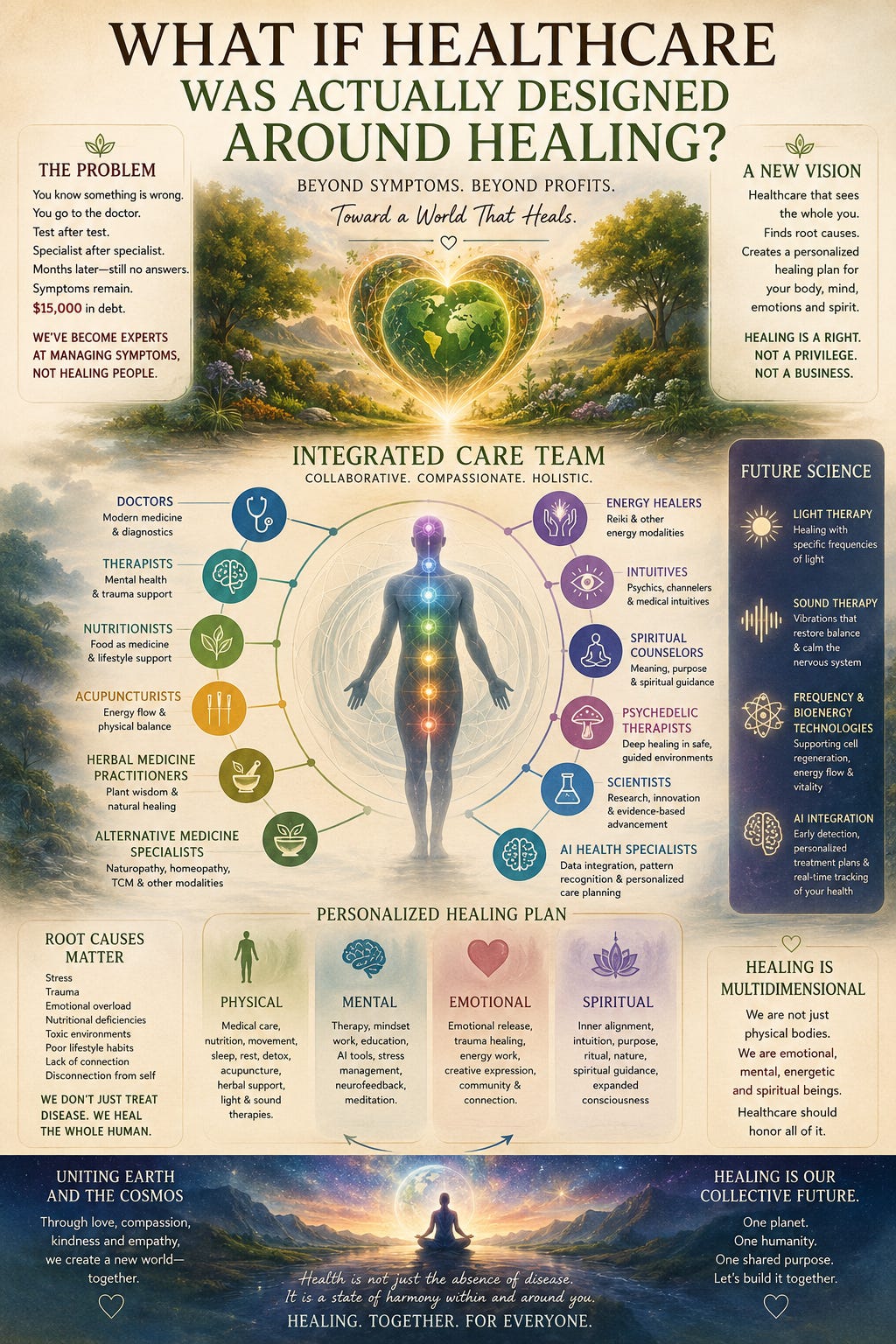
Imagine healthcare teams where practitioners collaborate instead of compete:
Doctors
Therapists
Nutritionists
Acupuncturists
Herbal medicine practitioners
Alternative medicine specialists
Energy healers (Reiki and other modalities)
Spiritual counselors
Intuitives (psychics, channelers, medical intuitives)
Scientists
AI health specialists
And in certain carefully guided and regulated environments:
Psychedelic-assisted therapists and facilitators working alongside mental health professionals
All working together to support one human being.
Not dismissing each other.
Listening to each other.
Because someone dealing with chronic illness may need:
Medical testing and diagnostics
Emotional and trauma support
Nervous system regulation
Nutritional healing
Acupuncture for energetic and physical balance
Herbal medicine to support the body naturally
Energy healing to help restore calm and energetic flow
Intuitive insight to uncover emotional or spiritual patterns that may be overlooked
Psychedelic-assisted therapy for deep trauma healing, depression, PTSD, or consciousness work in appropriate settings
Spiritual grounding and community support
Healing becomes multidimensional because people are multidimensional.
The role of future science in healing
I also think we’re entering a time where healthcare will expand far beyond pills and surgery alone.
We’re already seeing early versions of this.
Light therapy.
Sound therapy.
Frequency-based healing technologies.
The body responds to vibration more than we realize.
Certain sounds calm the nervous system.
Certain light frequencies support healing and regulation.
Even breath and rhythm affect the body’s internal state.
I believe future medicine will increasingly explore:
Biofrequency technologies
Light-based therapies
Sound and resonance healing
Nervous system recalibration
Energy and electromagnetic research
Not as “magic.”
But as science we are only beginning to understand.
How AI could completely transform healthcare
I also think AI will play a major role in the future of medicine.
Not replacing doctors.
Supporting them.
AI could help:
Detect patterns humans miss
Analyze full-body health trends
Create personalized treatment plans
Track long-term healing progress
Integrate data across physical, emotional, and behavioral health
Instead of fragmented information sitting in disconnected systems, AI could help practitioners finally see the bigger picture.
Imagine a healthcare system where someone’s:
Stress levels
Sleep patterns
Nutrition
Emotional state
Medical history
Nervous system responses
are all looked at together.
That changes the quality of care completely.
Why compassion still matters more than technology
But even with advanced science and AI, one thing cannot be replaced:
Human care.
People heal differently when they feel:
Safe
Seen
Heard
Supported
The nervous system responds to compassion.
A person who feels emotionally supported often heals differently than someone who feels rushed through a system.
That human connection matters.
More than most people realize.
What healthcare could become
I don’t think healthcare should revolve around profit generated from sickness.
I think it should revolve around helping people genuinely become well.
Not just functional enough to return to work.
Actually healthy.
Physically.
Mentally.
Emotionally.
Spiritually.
A system focused on prevention instead of endless crisis management.
A system where healing is accessible—not something that leaves people drowning in debt while still searching for answers.
Closing
The more I reflect on all of this, the more I believe the future of healthcare isn’t about rejecting modern medicine.
It’s about expanding our understanding of what healing really is.
Because human beings are not just physical bodies.
We are emotional.
Mental.
Energetic.
Relational.
Spiritual.
And maybe true medicine begins the moment we stop treating isolated symptoms…
and finally start caring for the whole person instead.