

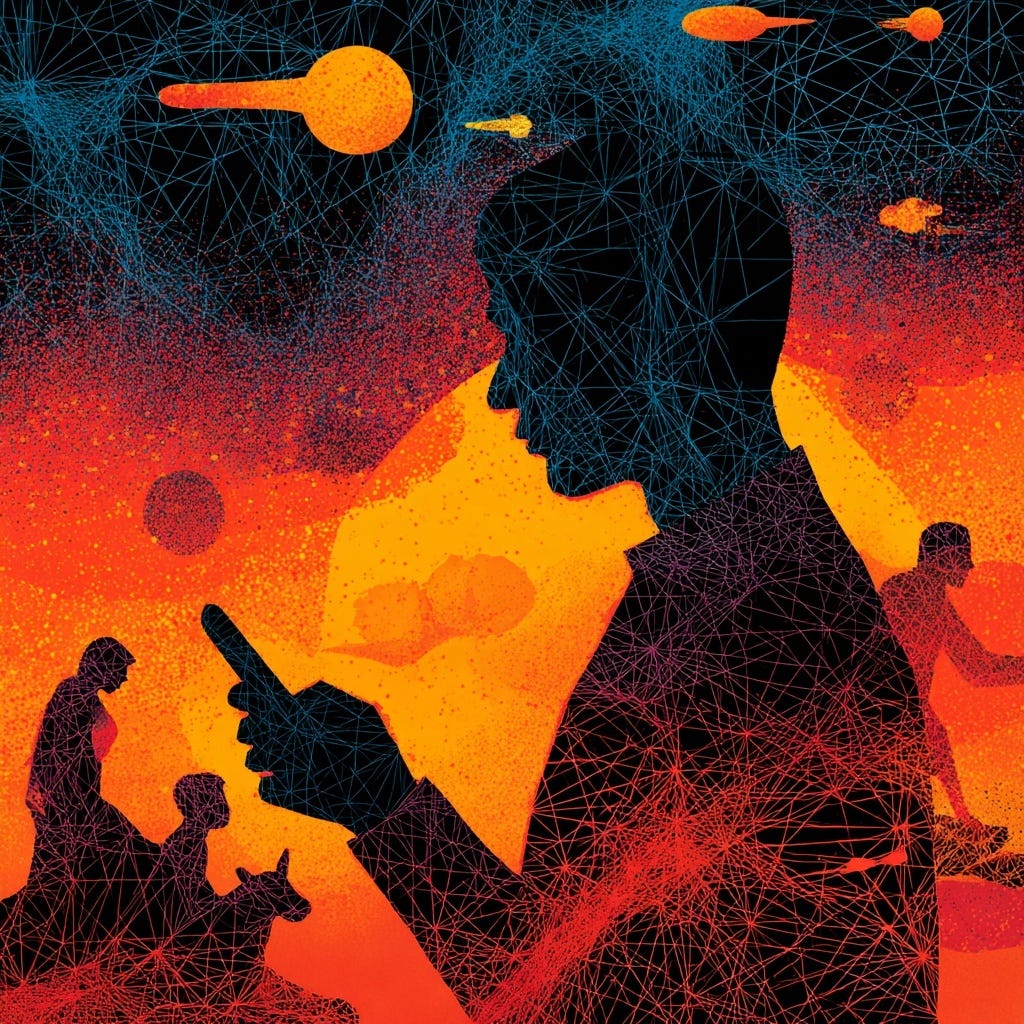
Sometimes I sit back and think about how strange this era really is.
Humanity has never been more connected digitally.
And yet so many people feel:
Lonely
Overstimulated
Emotionally exhausted
Distrustful
Disconnected from themselves
We can access almost any information instantly.
But truth somehow feels harder to find than ever.
And honestly, I think that says a lot about the stage humanity is moving through right now.
What I’ve been noticing online
The internet amplifies energy very quickly.
Fear spreads quickly.
Outrage spreads quickly.
Shame spreads quickly.
Misinformation spreads quickly.
But so does:
Compassion
Creativity
Healing
Awareness
Community
Digital spaces are not inherently good or bad.
They amplify consciousness.
And right now, many online systems are still heavily driven by:
Attention extraction
Emotional triggering
Profit optimization
Endless stimulation
Not necessarily emotional well-being or human flourishing.
What happens when algorithms shape human behavior
One thing that becomes obvious very quickly is this:
Technology doesn’t just reflect culture anymore.
It shapes it.
Algorithms influence:
Emotional states
Attention spans
Political polarization
Self-worth
Identity
Relationships
Perception of reality
And when systems are optimized primarily for engagement rather than wisdom or truth…
people eventually become emotionally dysregulated.
The nervous system was never designed for constant outrage, comparison, stimulation, and information overload.
The deeper thing many people are actually searching for
I honestly don’t think most people are addicted to information.
I think they’re searching for:
Connection
Meaning
Validation
Belonging
Safety
Understanding
And digital spaces often offer temporary emotional stimulation instead of genuine nourishment.
Which creates a cycle:
Consume more
Feel emptier
Consume more again
Meanwhile people slowly lose connection to:
Presence
Silence
Real relationships
Their own inner awareness
What a healthier digital culture could actually look like
I think future digital culture will eventually need to become more human-centered.
Not just optimized for profit and engagement.
But designed around:
Truth
Empathy
Emotional well-being
Ethical intelligence
Healthy communication
Collective responsibility
Imagine online spaces that encourage:
Nuanced conversations instead of instant outrage
Emotional regulation instead of emotional exploitation
Critical thinking instead of manipulation
Collaboration instead of division
Not perfection.
But greater awareness.
Why truth matters more than ever
One thing I’ve realized is that truth becomes harder to access in environments overwhelmed by noise.
And right now, many people are overwhelmed:
Too much information
Too many opinions
Too many emotional triggers
Too little stillness
Which makes discernment incredibly important.
Not blind trust.
Not blind skepticism either.
But learning how to:
Pause
Reflect
Observe patterns
Feel into what creates clarity versus confusion
Because misinformation spreads fastest when people are emotionally dysregulated.
The role of empathy online
It’s easy to forget there’s a human nervous system on the other side of a screen.
A real person.
A real emotional life.
A real story.
Digital culture often rewards dehumanization:
Quick judgment
Public shaming
Tribal thinking
Emotional projection
But empathy slows things down.
It creates space.
And honestly, I think humanity desperately needs more spaces where people feel:
Heard
Respected
Safe enough to be human again
Even when disagreement exists.
What AI is revealing about humanity
AI feels like one of the biggest mirrors humanity has ever created.
Because AI reflects:
Human knowledge
Human values
Human biases
Human intentions
Which means the deeper question isn’t only:
“What can AI do?”
It’s:
“What kind of humanity is guiding it?”
Because technology amplifies consciousness too.
If driven primarily by greed, control, and manipulation, AI could deepen instability.
But if guided by:
Wisdom
Compassion
Human rights
Collective well-being
Long-term thinking
It could support enormous positive transformation.
What ethical AI governance could actually mean
I think future AI systems will need frameworks rooted in:
Transparency
Accountability
Human dignity
Emotional and psychological safety
Environmental sustainability
Ethical responsibility
Not just corporate competition.
Because eventually AI will influence:
Healthcare
Education
Media
Justice systems
Economic systems
Emotional support systems
Environmental planning
And if those systems are disconnected from empathy and wisdom, the consequences could scale very quickly.
The relationship between AI and planetary wellbeing
One thing I keep thinking about is this:
Future intelligence—human or artificial—cannot survive on a dying planet.
Which means technological advancement and planetary stewardship eventually become inseparable.
AI could potentially help humanity:
Reduce waste
Improve sustainability systems
Coordinate resources more intelligently
Detect environmental risks earlier
Improve healthcare access
Support global collaboration
But only if humanity chooses to align technology with life instead of endless extraction.
What digital wisdom might actually look like
I think future digital maturity may involve learning:
When to disconnect
How to regulate emotionally online
How to communicate responsibly
How to protect mental health
How to engage critically without becoming cynical
Because intelligence without wisdom becomes dangerous.
And information without emotional maturity becomes destabilizing.
What gives me hope
What gives me hope is that many people are already questioning the current direction.
People are searching for:
More authentic communities
Slower and healthier relationships with technology
Truth over constant noise
More intentional online spaces
Technology that supports humanity instead of draining it
There’s a growing awareness that endless stimulation is not the same thing as fulfillment.
And honestly, I think that awareness is important.
Closing
I don’t think technology is the problem.
I think unconsciousness is.
Because every tool humanity creates eventually reflects the emotional and ethical maturity of the people using it.
And maybe the real challenge isn’t simply building more advanced AI.
Maybe it’s whether humanity can evolve enough emotionally, ethically, and spiritually to guide that intelligence responsibly.
With:
Truth
Wisdom
Compassion
Empathy
Responsibility
Human dignity
Care for future generations
Respect for the Earth itself
Because the future of technology may ultimately depend on one simple question:
Can humanity learn to become as emotionally mature as the tools it is creating?