

There was a conversation I had recently that stayed with me.
Someone asked me, “How much do you charge for healing?”
I paused.
Because the question wasn’t just about money.
It was about value. Worth. Exchange.
And I realized… most of us were never really taught how to relate to money in a way that feels whole.
What I’ve been noticing about money and energy
In my work, I see this pattern a lot.
People either:
Overgive and feel drained
Or hold tightly and feel scarcity
Very rarely do they feel balanced.
Because money, at its core, is just energy exchange.
But somewhere along the way, we disconnected it from the heart.
We turned it into something transactional…
instead of relational.
What changes when we move toward a shared way of living
I’ve been exploring the idea of a shared economy—not as a concept, but as a lived experience.
Moments where:
People offer what they can
Receive what they need
And trust that it balances out over time
Not perfectly. But naturally.
I’ve seen this happen in small ways:
A session offered freely… returned later as support, connection, or opportunity.
It doesn’t always come back in the same form.
But it comes back.
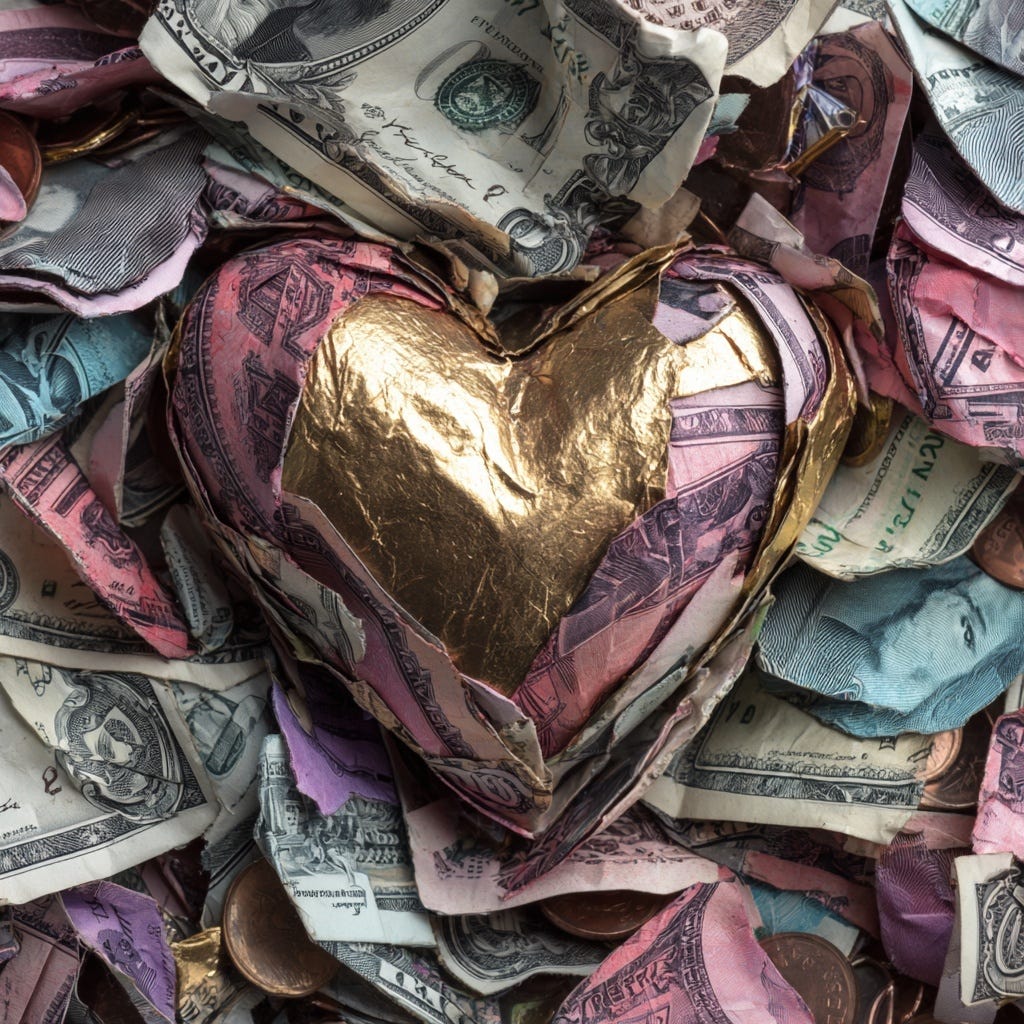
What “love currency” actually feels like
There’s something I’ve been feeling more into lately.
A different kind of currency.
Not something you can track in numbers—but something you feel immediately.
Love currency shows up as:
Presence
Care
Generosity without calculation
Receiving without guilt
It’s the moment when someone says, “I’ve got you,” and you believe them.
And interestingly…
When that’s present, the stress around money starts to soften.
The values that quietly shape everything
Growing up, I was exposed to different teachings, but only recently did I start to really understand them through experience.
In Confucius’s framework, there are five virtues:
Benevolence (Ren)
Righteousness (Yi)
Propriety (Li)
Wisdom (Zhi)
Trustworthiness (Xin)
And in Buddhism, there’s a deep emphasis on:
Compassion
Non-attachment
Right livelihood
Reducing suffering
When you look at both…
They’re not abstract ideals.
They’re practical guidelines for how we relate—to each other, to resources, to life itself.
What education never really taught us
No one really taught us:
How to feel safe giving and receiving
How to define “enough”
How to align our work with our values
We learned how to earn.
But not how to relate.
Imagine if from a young age, we were taught:
Emotional awareness alongside financial literacy
Community care alongside personal success
Contribution as much as accumulation
That would change everything.
What I’m starting to practice in my own life
I’m still figuring this out.
But here’s what I’ve been leaning into:
Charging when it feels aligned
Offering when it feels right
Trusting that value isn’t always immediate or measurable
And most importantly…
Paying attention to how I feel in the exchange.
Because when something feels off, it usually is.
And when something feels open, mutual, and grounded—
there’s a different kind of flow.
What this could look like at a larger scale
If I zoom out, I can start to imagine something different:
Systems that prioritize well-being, not just output
Communities where resources circulate, not accumulate
Work that feels meaningful, not just profitable
Where dignity isn’t tied to income.
And support isn’t conditional.
Closing
I don’t think the question is just how we redesign financial systems.
I think it’s deeper than that.
It’s how we redefine value.
Because when value is rooted in the heart—
in care, trust, and shared humanity—
everything else starts to reorganize around it.
And maybe that’s where real prosperity begins.